About 19 minutes
Monument — Themes and Context
Social Speculation
4,302 recorded words. 1 minutes difference from this book's estimate.
View Gutenberg source #60803

For Wedding Day — Inside the Classic, the stored edition analysis reports 4,380 words, 20 min estimated reading time, and 1 detected text section.
The text analysis averages about 19.3 words per sentence, while the detected sections provide another way to judge how the source is divided.
Project Gutenberg metadata also associates the work with “Science fiction,” connecting these edition facts with the source record’s subject description.
Explore this collection
These alternatives are selected using recorded categories and estimated reading time.
About 19 minutes
Social Speculation
4,302 recorded words. 1 minutes difference from this book's estimate.
View Gutenberg source #60803About 18 minutes
Social Speculation
4,040 recorded words. 2 minutes difference from this book's estimate.
View Gutenberg source #60999About 24 minutes
Social Speculation
5,311 recorded words. 4 minutes difference from this book's estimate.
View Gutenberg source #59309Search stored excerpts and compare books → Choose by your preferences →
Choices use stored catalog measurements. Estimates vary with reading speed. A shared category is a catalog label, not a claim that two books have the same argument or literary quality.
Search reads excerpt text stored with this catalog and links to its associated Gutenberg record. The connection is stored in the site database; this tool does not recheck that every excerpt is word-for-word identical to that external record. Excerpt search does not cover every chapter and does not verify historical publication dates.
Catalog snapshot checked: 2026-09-26. Coverage: 96 public books, 96 available source excerpts.
Calculated from edition completeness, EPUB availability, text structure and catalogue metadata. Not a user rating.
Total of 100 points, scaled to a 2.5-5.0 range. Editions with an empty description or a missing EPUB file are not scored.
Public-domain source text
The source text is kept in the dedicated reader, separate from this catalogue record and its commentary.
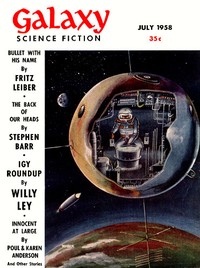
Winston Marks's 1955 story opens not with a wedding ceremony but with a breakfast-table argument over coffee strength. Four women—Polly, June, Doris, and Sue—debate how to accommodate the man they will all marry, Hollis Jamison. The scene immediately establishes the story's central premise: in a society where the ratio of women to men is five to one, marriage is a carefully regulated group arrangement called a quadracell. The women have been screened for compatible tastes in colors, foods, and video programs, yet their conversation reveals persistent friction over whose habits should yield. The argument is conducted partly through telepathic exchange, a detail that marks the story as science fiction even as its concerns remain domestic and psychological.
The story's worldbuilding is delivered through casual dialogue rather than exposition. Doris reminds the others that "it's five women to one man right now" and that the law "only requires a quadracell." This offhand remark implies a legal minimum for marriage units, suggesting that polygynous group marriage has been codified to manage a demographic crisis. The women have been "carefully schooled ambiverts of roughly equal education," and their differences in skills and personalities are meant to complement each other. Yet the narrative notes that "the unpredictable quality of the most stable feminine emotions" makes mate selection difficult. The system is presented as rational but fragile, dependent on screening that cannot eliminate all conflict.
The breakfast argument reveals the tensions beneath the surface of the quadracell. Polly defends strong coffee because "men like it strong," while June resists changing all their habits to conform to one man. Doris counters with a blunt reminder of the demographic imbalance: "Back when there was a man for practically every woman, it was different." The women's roles are specialized—Polly cooks, June plays chess, Doris is witty, Sue is physically attractive—and they are aware that these traits are assets in the marriage market. Sue, described as the arbiter who "ruled the quartet with a gentle but confident mind," mediates the dispute. The scene shows that even with careful matching, the women must continually negotiate their individual preferences against the demands of the group marriage.
Although the story is cataloged as science fiction, its speculative elements—the five-to-one ratio, telepathic conversation, and the bureau that screens marriage cells—serve primarily to frame a psychological drama. The excerpts offer no explanation for the skewed sex ratio; the focus remains on the women's internal dynamics and their anticipation of the wedding. The narrative voice is close to the characters, reporting their thoughts and the unspoken awareness that Sue's "lithe, athletic body" is the quartet's greatest asset. The story's title, Wedding Day, points to the event that will test whether the carefully constructed cell can hold. Readers should expect a character-driven story that uses its speculative setting to examine conformity, competition, and cooperation among women in a constrained social system.
The excerpts do not reveal whether the wedding takes place or how Hollis Jamison behaves. What they offer is a concentrated portrait of four women negotiating a shared future under unusual constraints. Marks builds tension not through plot mechanics but through small domestic decisions—coffee strength, chess games, whose apartment they live in—that carry weight in a world where marriage is a bureaucratic as well as a personal arrangement. Readers interested in mid-century speculative fiction that prioritizes social and psychological detail over technological invention will find this story a compact example of the mode.
There’s a particular ache in watching those four women brace themselves on their wedding day, each negotiating her own private surrender to a shared future. It reminded me, oddly, of the quieter, older anxieties in The Downhill Side of Thirty — Reading Companion—not the ceremony, but the slow, unspoken calculus of what we give up just to stay. That book feels like a whispered footnote to this one. I think about that often. — The way we carry our choices, barely visible, even in joy.
A brief reflection can help important ideas stay with you longer.