About 47 minutes
The Trouble with Truth — Context and Discussion
Social Speculation
10,781 recorded words. 17 minutes difference from this book's estimate.
View Gutenberg source #53123
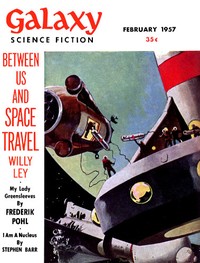
This digital edition of I Am a Nucleus — Reading Notes is described by source-level measurements including 14,695 words, 1 hr 4 min estimated reading time, and 2 detected text sections.
The text analysis averages about 14.1 words per sentence, while the detected sections provide another way to judge how the source is divided.
Project Gutenberg metadata also associates the work with “Science fiction,” connecting these edition facts with the source record’s subject description.
Explore this collection
These alternatives are selected using recorded categories and estimated reading time.
About 47 minutes
Social Speculation
10,781 recorded words. 17 minutes difference from this book's estimate.
View Gutenberg source #53123About 44 minutes
Social Speculation
10,050 recorded words. 20 minutes difference from this book's estimate.
View Gutenberg source #58883About 43 minutes
Social Speculation
9,801 recorded words. 21 minutes difference from this book's estimate.
View Gutenberg source #59224Search stored excerpts and compare books → Choose by your preferences →
Choices use stored catalog measurements. Estimates vary with reading speed. A shared category is a catalog label, not a claim that two books have the same argument or literary quality.
Search reads excerpt text stored with this catalog and links to its associated Gutenberg record. The connection is stored in the site database; this tool does not recheck that every excerpt is word-for-word identical to that external record. Excerpt search does not cover every chapter and does not verify historical publication dates.
Catalog snapshot checked: 2026-09-26. Coverage: 96 public books, 96 available source excerpts.
Calculated from edition completeness, EPUB availability, text structure and catalogue metadata. Not a user rating.
Total of 100 points, scaled to a 2.5-5.0 range. Editions with an empty description or a missing EPUB file are not scored.
Public-domain source text
The source text is kept in the dedicated reader, separate from this catalogue record and its commentary.
The narrator's voice in I Am a Nucleus is established immediately through a blend of weary humor and precise physical detail. The opening paragraph—'No doubt whatever about it, I had the Indian sign on me'—sets a tone of rueful self-awareness that persists throughout the excerpts. The protagonist, Alec, describes his apartment as having an 'absentee-wife look' and notes the discrepancy between the radio's reported temperature and his own Greenwich Village thermometer, a small but telling detail that signals his attention to the gap between official reality and personal experience.
This observational precision extends to the chain of mishaps that follow: a missed alarm, a sudden downpour, a taxi that won't start, and a subway system that seems conspiratorially out of sync. Barr's prose moves from the mundane to the uncanny without shifting register, grounding the fantastic in the quotidian.
The narrator's word choices consistently convey a world that is slightly off-kilter. He describes his day as one where he was 'not so much tired as beaten down,' and the apartment looks 'woebegone'—a word that personifies the space with a melancholy that feels both comic and genuine. The dialogue is similarly crafted: the taxi driver's 'Sorry, Mac. You'll have to find another cab. Good hunting' is a casual dismissal that carries an edge of urban indifference. Later, when Alec's wife Molly calls him 'duck,' the affectionate nickname contrasts with the growing tension, showing how Barr uses colloquial speech to anchor the story in recognizable human relationships even as events grow stranger.
Alec's first-person narration maintains a consistent tone of beleaguered rationality. He describes the discovery of the 'chunk of dirty glass, the size of an old-fashioned hatbox' with the same matter-of-factness he uses for the weather. The explosion that follows is 'so feeble a thing'—a deliberate understatement that highlights his attempt to minimize the extraordinary. This voice is crucial to the story's effect: the reader is invited to share Alec's perspective, where the bizarre is processed through a filter of everyday complaint. Even when his friend McGill suggests he might be able to influence chance, Alec responds with a grumble: 'I don't want to seem ungrateful, but I wish it would go and help somebody else.' The humor arises from the gap between the cosmic implications and the narrator's mundane priorities.
The excerpts reveal a narrative structure built on a cascade of small, improbable events. The story opens with a series of everyday frustrations—a missed train, a rainstorm, a broken taxi—that escalate into phenomena that defy explanation: a street light going off, a police car blowout, a radio report blaming Alec for jamming elevators and cutting power. Barr controls the pacing by alternating between Alec's internal commentary and external action. The scene in McGill's lab, where Alec is 'taped up and surrounded with gadgets,' provides a moment of pseudo-scientific analysis that only deepens the mystery. The structure mirrors the protagonist's growing sense of being hemmed in, as each new event adds another layer of inexplicable cause and effect.
The story is firmly rooted in a specific time and place: mid-century New York City. References to 'Greenwich Village,' 'Madison and Fifty-fourth,' and the 'Westshore Drive' anchor the narrative in real geography. The details of urban life—a 'story conference at one of the TV studios,' a 'pneumatic drill' breaking up clay at an excavation site, a radio voice saying 'the town is gripped in superstitious fear'—create a backdrop of mundane modernity against which the supernatural elements stand out. Barr uses the city's infrastructure (subways, elevators, power grids) as both setting and plot device: the mysterious force that attaches to Alec disrupts these systems, turning the familiar urban landscape into a source of threat. The contrast between the ordinary setting and the extraordinary events is a key source of the story's tension.
Readers approaching I Am a Nucleus should attend to how Barr balances the narrator's sardonic voice with the growing strangeness of the plot. The excerpts suggest a story that is as much about the experience of being caught in a chain of inexplicable events as it is about the explanation for them. Pay attention to the way small details—a missed alarm, a broken lock, a radio broadcast—accumulate into a pattern that the characters themselves are only beginning to understand. The novella rewards close reading of its dialogue and description, where the ordinary and the uncanny coexist.
Remembering that TV writer’s weary, sardonic shuffle through Manhattan, I found myself oddly comforted by the same wry tone in The Downhill Side of Thirty — Reading Companion. There’s a shared knack for finding the absurd in the ordinary, for laughing quietly at one’s own bad luck. It felt like meeting an old friend, not for advice, but just to sit with. A familiar kind of tiredness, knowing and gentle.
Save your reaction, strongest insight, and memorable passage.