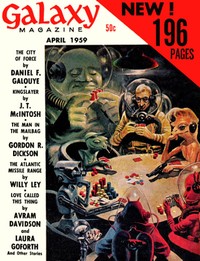
About 35 minutes
Vassi — Themes and Context
Space Future
7,943 recorded words. 1 minutes difference from this book's estimate.
View Gutenberg source #60921

Time Payment — Inside the Classic can be approached with a clearer sense of reading commitment from its source measurements: 8,054 words, 36 min estimated reading time, and 1 detected text section.
The text analysis averages about 16.6 words per sentence, while the detected sections provide another way to judge how the source is divided.
Project Gutenberg metadata also associates the work with “Science fiction,” connecting these edition facts with the source record’s subject description.
Explore this collection
These alternatives are selected using recorded categories and estimated reading time.
About 35 minutes
Space Future
7,943 recorded words. 1 minutes difference from this book's estimate.
View Gutenberg source #60921About 38 minutes
Space Future
8,710 recorded words. 2 minutes difference from this book's estimate.
View Gutenberg source #51336About 38 minutes
Space Future
8,722 recorded words. 2 minutes difference from this book's estimate.
View Gutenberg source #51351Search stored excerpts and compare books → Choose by your preferences →
Choices use stored catalog measurements. Estimates vary with reading speed. A shared category is a catalog label, not a claim that two books have the same argument or literary quality.
Search reads excerpt text stored with this catalog and links to its associated Gutenberg record. The connection is stored in the site database; this tool does not recheck that every excerpt is word-for-word identical to that external record. Excerpt search does not cover every chapter and does not verify historical publication dates.
Catalog snapshot checked: 2026-09-26. Coverage: 96 public books, 96 available source excerpts.
Calculated from edition completeness, EPUB availability, text structure and catalogue metadata. Not a user rating.
Total of 100 points, scaled to a 2.5-5.0 range. Editions with an empty description or a missing EPUB file are not scored.
Public-domain source text
The source text is kept in the dedicated reader, separate from this catalogue record and its commentary.
The story opens with a hardboiled gangster, Slick Tennant, who uses his 'sixth sense' to evade the Feds by hiding in the future. He strong-arms Dr. Richard Porter, inventor of the Metachronoscope, into sending him forward. The early pages establish a classic crime setup—threats, a kidnapped child, and a forced journey—but the narrative quickly pivots when Slick emerges into a world where his senses are stripped away.
The excerpts show a deliberate shift in tone: from the gritty, slang-heavy dialogue of Slick's gangland to the clinical, almost philosophical discussions of 'conditioning' and 'blank time.' This contrast is the engine of the story, and readers should watch how the author uses Slick's limited perspective to gradually reveal the rules of this future society.
The opening chapters are driven by Slick Tennant’s vernacular. He speaks in contractions and dropped g's: 'That'll learn you not to pull none of your high-brow stuff.' The doctor, by contrast, insists on precise terminology—'Metachronoscope' not 'time machine'—and speaks in a soothing, professional tone. This linguistic clash is more than characterization; it mirrors the story’s central tension between brute force and intellectual control.
Notice how the author uses Slick’s own narration to undercut his toughness. He is careful not to tip too much or too little, yet he is out of his depth once the machine activates. The doctor’s calm correction of Slick’s language is a subtle power play that foreshadows who ultimately holds the cards.
After the time jump, Slick experiences what the text calls 'the blank'—a twenty-year period during which he is conscious but unable to hear, feel, or smell. The excerpts reveal this through a conversation with another 'blank' survivor, who describes coming out of it: 'I can consciously hear, and feel, and smell, just like other people.' Slick’s own emergence is gradual, 'sneaking up' on him.
This is not a typical time-travel adventure. The future is not a place of wonders but of sensory deprivation. The author focuses on the subjective experience of returning to full perception, making the reader feel the weight of lost time. The 'blank' is a punishment that fits the crime of trying to escape consequences.
Once Slick regains his senses, he explores a city that has reversed the relationship between crime and confinement. He observes that law-abiding citizens live in 'luxurious apartments that were nothing more than cells, with four-sided soundproofing,' while those who have been 'conditioned' (former criminals) enjoy the freedom of the countryside. The text describes 'Recidivist Gardens' as a place where the conditioned can experience nature.
This inversion is the story’s most striking worldbuilding detail. The author does not explain how this system works or whether it is just; instead, it is presented through Slick’s bewildered eyes. Readers should note how the setting comments on the opening premise: Slick tried to escape justice, but the future has redefined justice as a therapeutic re-education.
Late in the excerpts, the characters discuss 'conscious fore-memories'—glimpses of the future that are mixed with post-memories and impossible to date. One character says, 'you don’t know which part of the dream is a fore-memory until it happens.' This idea introduces a layer of temporal ambiguity that complicates the linear narrative.
The author uses this concept to create a quiet uncertainty. Slick’s newfound sensory awareness is paired with the possibility that his memories of the future might be unreliable. This is not a plot twist but a thematic note: even after emerging from the blank, perception remains slippery. The story ends not with a resolution but with Slick heading to the opera, leaving the reader to wonder how much of his experience is real.
The excerpts offer a complete arc—from crime to punishment to a tentative new life—but they leave key questions open. How does the conditioning work? Is Slick truly reformed, or merely adapted? The story rewards attention to small details: the doctor’s insistence on correct terms, the physical sensations of the ground-cover, the offhand mention of a Tri-di-cast. These are not decorations but clues to the world’s logic. Read for the way the author turns a pulp premise into a quiet, unsettling meditation on what it means to be present in one’s own life.
That book about the gangster and the twenty-year blank—it stayed with me long after, not the crime, but the quiet way it questions everything we think is real. It made me wonder about how we’re all conditioned. A friend once mentioned Security Plan — A Reader’s Guide in that same soft, wondering tone, like it holds a similar mirror to our own perceptions.
Capture what you thought, learned, and would like to remember.