About 337 minutes
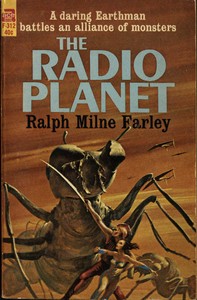
The Radio Planet — Themes and Context
Space Future
77,419 recorded words. 82 minutes difference from this book's estimate.
View Gutenberg source #52326
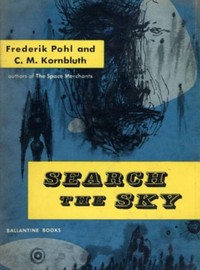
For Search the Sky — Inside the Classic, the stored edition analysis reports 58,636 words, 4 hr 15 min estimated reading time, and 17 detected text sections.
The text analysis averages about 12.5 words per sentence, while the detected sections provide another way to judge how the source is divided.
Project Gutenberg metadata also associates the work with “Science fiction,” connecting these edition facts with the source record’s subject description.
Explore this collection
These alternatives are selected using recorded categories and estimated reading time.
About 337 minutes
Space Future
77,419 recorded words. 82 minutes difference from this book's estimate.
View Gutenberg source #52326About 62 minutes
Space Future
14,119 recorded words. 193 minutes difference from this book's estimate.
View Gutenberg source #58798About 59 minutes
Space Future
13,541 recorded words. 196 minutes difference from this book's estimate.
View Gutenberg source #51810Search stored excerpts and compare books → Choose by your preferences →
Choices use stored catalog measurements. Estimates vary with reading speed. A shared category is a catalog label, not a claim that two books have the same argument or literary quality.
Search reads excerpt text stored with this catalog and links to its associated Gutenberg record. The connection is stored in the site database; this tool does not recheck that every excerpt is word-for-word identical to that external record. Excerpt search does not cover every chapter and does not verify historical publication dates.
Catalog snapshot checked: 2026-09-26. Coverage: 96 public books, 96 available source excerpts.
Calculated from edition completeness, EPUB availability, text structure and catalogue metadata. Not a user rating.
Total of 100 points, scaled to a 2.5-5.0 range. Editions with an empty description or a missing EPUB file are not scored.
Public-domain source text
The source text is kept in the dedicated reader, separate from this catalogue record and its commentary.
The word 'decay' opens the novel, planted in Ross's mind as he stands on the traders' ramp. The spaceport is clean and bustling, yet the 'imperceptible reek of decay' pervades Halsey's Planet. The contrast between the efficient Yards and the 'tumble-down gray acres of Ghost Town' sets up a central tension: progress versus entropy. Ross's walk to work through Ghost Town, a place he once played in as a child, reveals that the abandoned district has grown—an acre a year, a street a month. Specialists offer conflicting explanations: psychological, biological, technological. But Ross wonders how many Ghost Towns lie 'corpselike' on the planet's surface.
The novel presents a chorus of specialists, each offering a single, non-overlapping cause for Ghost Town's expansion. One calls it 'a purely psychological phenomenon,' another 'a purely biological phenomenon,' a third 'a purely technological problem.' Each guarantees his answer is complete. Ross, however, sees the problem as 'a purely psychological-biological-technological-educational-demographic problem'—a sardonic list that underscores the fragmentation of knowledge. The specialists' confidence contrasts with the physical decay Ross smells and sees. The text does not reveal which explanation is correct, but the pattern suggests that compartmentalized expertise may miss the larger picture.
On Azor, Ross learns that stealing is against the law, but preaching equality is 'against the state' and carries the maximum penalty. This inversion of values—where a social ideal becomes a grave offense—creates a darkly comic tension. Bernie, a local, warns Ross that even mentioning equality can lead to prosecution. When Ross suggests stealing to fund his escape, Bernie clarifies the hierarchy of crimes. The casual mention of 'female bloodsuckers' and a 'battleship-class female' manager hints at gendered power dynamics on Azor. The jail itself lacks beds, and Bernie recites a catalog of which cities have them, as if this knowledge is a survival skill.
Ross tells Helena and Bernie that 'the fate of the human race' hangs on what happens to him. They exchange a look and respond soothingly, as if humoring a delusion. The text does not confirm whether Ross's claim is true or paranoid, but it establishes a pattern: Ross carries a burden others cannot fully grasp. His decision to leave Halsey's Planet is not a simple escape; it is a gamble with cosmic stakes. The jail scene on Azor reinforces this: Ross lies on the floor, trying to get comfortable, while Bernie recites trivia about local jails. The mundane details of incarceration contrast sharply with Ross's grand pronouncement, leaving the reader to weigh the evidence.
The excerpts offer a fragmented view: a planet in decay, a society that criminalizes equality, and a protagonist who may be either a savior or a fool. Readers should attend to the recurring motif of measurement—acres, streets, blocks—and the way characters reduce complex problems to single causes. The novel's title, Search the Sky, suggests an outward quest, but the opening chapters focus inward, on rot and confinement. Whether Ross's journey will find renewal or more decay remains an open question.
Ross’s fretful stepping-stones between worlds—each a ghost of someone else’s certainty—put me in mind of a quieter shelf-mate. There’s a fondness I keep for Welcome, Martians! — Edition Insights, whose margins whisper about arrivals, not escapes. Both books share that ache of wondering whether we’re decaying or merely unfolding, like old paper deciding, very slowly, what it wants to become.
Build a private reading journal entry for this title.