About 63 minutes
Advance Agent — A Closer Reading
Other Worlds
14,322 recorded words. 0 minutes difference from this book's estimate.
View Gutenberg source #51273
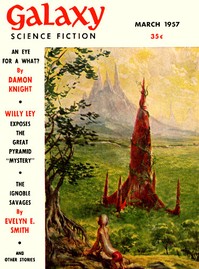
Before opening The Ignoble Savages — Reading Companion, the edition data offers a quick orientation: 14,466 words, 1 hr 3 min estimated reading time, and 2 detected text sections.
The text analysis averages about 16.0 words per sentence, while the detected sections provide another way to judge how the source is divided.
Project Gutenberg metadata also associates the work with “Science fiction,” connecting these edition facts with the source record’s subject description.
Explore this collection
These alternatives are selected using recorded categories and estimated reading time.
About 63 minutes
Other Worlds
14,322 recorded words. 0 minutes difference from this book's estimate.
View Gutenberg source #51273About 72 minutes
Other Worlds
16,550 recorded words. 9 minutes difference from this book's estimate.
View Gutenberg source #51735About 72 minutes
Other Worlds
16,410 recorded words. 9 minutes difference from this book's estimate.
View Gutenberg source #51824Search stored excerpts and compare books → Choose by your preferences →
Choices use stored catalog measurements. Estimates vary with reading speed. A shared category is a catalog label, not a claim that two books have the same argument or literary quality.
Search reads excerpt text stored with this catalog and links to its associated Gutenberg record. The connection is stored in the site database; this tool does not recheck that every excerpt is word-for-word identical to that external record. Excerpt search does not cover every chapter and does not verify historical publication dates.
Catalog snapshot checked: 2026-09-26. Coverage: 96 public books, 96 available source excerpts.
Calculated from edition completeness, EPUB availability, text structure and catalogue metadata. Not a user rating.
Total of 100 points, scaled to a 2.5-5.0 range. Editions with an empty description or a missing EPUB file are not scored.
Public-domain source text
The source text is kept in the dedicated reader, separate from this catalogue record and its commentary.
The Ignoble Savages opens with a staged farewell between Larhgan, the high priestess, and Skkiru, a beggar, as they prepare for the arrival of Earthmen. The Snaddrath have adopted a "primitive" way of life to conceal their true underground civilization, a ruse that immediately introduces the novella's central tension: the performance of culture for an external audience. The narrative shifts between the Snaddrath's orchestrated scenes and the Earth ethnologists' interpretations, creating a layered structure where every gesture—Skkiru's triple somersault, Bbulas's jewel-studded robe—carries double meaning.
The story alternates between the Snaddrath's preparations and the Earthmen's field notes, generating dramatic irony. Readers see both the artifice—Skkiru's mudshoes worn only once, the "hut" that is nearly a palace—and the ethnologists' attempts to rationalize these anomalies. Cyril, the more skeptical Earthman, questions why a society with complex social structures wears inadequate clothing, while Raoul eagerly fits observations into textbook patterns. This split perspective invites readers to watch the watchers, noting how each side misreads the other.
Costume and props are central to the Snaddrath's deception. Bbulas wears spectacles because contact lenses are "not considered backward enough," and the robe's embroidery hinders his attempt to wipe them—a small detail that underscores the friction between role and reality. Skkiru's cigarette craving, denied because tobacco is not indigenous, highlights how the performance suppresses personal desire. The roof that leaks yet the building is called a "hut" exemplifies the gap between signifier and signified, a motif that recurs in the Earthmen's debates about cultural anomalies.
The novella moves rapidly between intimate Snaddrath scenes—the council chamber, the beggar's encounter—and the Earthmen's quarters, where Cyril and Raoul analyze data. This spatial alternation mirrors the thematic oscillation between surface and depth. The Earthmen's tent, with its "hardened" cots and smoke rings, contrasts with the Snaddrath's mud and jeweled robes, emphasizing the collision of two worlds. Each shift in setting recalibrates the reader's understanding: what seemed like primitive behavior is revealed as calculated performance, and vice versa.
Dialogue distinguishes the two groups. The Snaddrath speak in melodramatic, almost theatrical tones—"Of what importance are fifteen minutes compared to eternity!"—while the Earthmen use clinical, academic language: "Environmental pressures seem to have had no effect upon their culture." This contrast not only defines character but also signals the novella's satirical edge. The Snaddrath's inflated rhetoric, borrowed from Terrestrial fictapes, hints at cultural contamination, while the Earthmen's detached analysis misses the emotional stakes. The result is a comedy of miscommunication where neither side fully grasps the other's reality.
Readers attentive to the novella's structure will find that the gaps between what is shown and what is said—the mudshoes, the leaking roof, the borrowed rhetoric—are where the story's meaning resides. Smith uses these discrepancies not as plot holes but as deliberate signals of the Snaddrath's predicament. The work rewards a careful eye for detail and a willingness to question both the natives' performance and the ethnologists' conclusions.
I finished that Snaddrath book and couldn’t shake how its staged primitiveness made me question what was real. It reminded me of another story, gentler but with the same ache inside its politeness. The Polite People of Pudibundia — Story, Setting & Ideas lingers like a half-remembered conversation, where everyone’s kindness is a quiet performance we’re never quite let in on.
Capture what you thought, learned, and would like to remember.