About 19 minutes
The Long, Silvery Day — Inside the Classic
Other Worlds
4,193 recorded words. 1 minutes difference from this book's estimate.
View Gutenberg source #51550
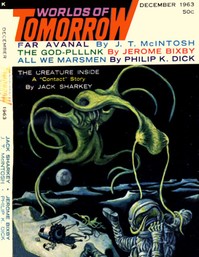
The source record for The God-Plllnk — Context and Discussion measures this digital text at 4,423 words, 20 min estimated reading time, and 1 detected text section.
The text analysis averages about 19.4 words per sentence, while the detected sections provide another way to judge how the source is divided.
Project Gutenberg metadata also associates the work with “Science fiction,” connecting these edition facts with the source record’s subject description.
Explore this collection
These alternatives are selected using recorded categories and estimated reading time.
About 19 minutes
Other Worlds
4,193 recorded words. 1 minutes difference from this book's estimate.
View Gutenberg source #51550About 22 minutes
Other Worlds
4,873 recorded words. 2 minutes difference from this book's estimate.
View Gutenberg source #59495About 23 minutes
Other Worlds
5,067 recorded words. 3 minutes difference from this book's estimate.
View Gutenberg source #51574Search stored excerpts and compare books → Choose by your preferences →
Choices use stored catalog measurements. Estimates vary with reading speed. A shared category is a catalog label, not a claim that two books have the same argument or literary quality.
Search reads excerpt text stored with this catalog and links to its associated Gutenberg record. The connection is stored in the site database; this tool does not recheck that every excerpt is word-for-word identical to that external record. Excerpt search does not cover every chapter and does not verify historical publication dates.
Catalog snapshot checked: 2026-09-26. Coverage: 96 public books, 96 available source excerpts.
Calculated from edition completeness, EPUB availability, text structure and catalogue metadata. Not a user rating.
Total of 100 points, scaled to a 2.5-5.0 range. Editions with an empty description or a missing EPUB file are not scored.
Public-domain source text
The source text is kept in the dedicated reader, separate from this catalogue record and its commentary.
Jerome Bixby's 1963 story opens with two alien priests, Grg and Yrl, awaiting the landing of a 'God' on Phobos, the moon of Mars. The narrative immediately establishes a dual focus: the grandeur of the approaching deity and the mundane irritation of the parasitic plllnk that bites the priests. This juxtaposition of the cosmic and the trivial sets the tone for a story that balances reverence with irony.
The aliens are described as octopidal, with double tentacles and a reproduction pouch, and they move by flowing, creeping, and oozing across the cold-crusted sand. Their language includes terms like Fsgh and Ffssgghh for priestly ranks, and they view Mars as the 'Seeing-All Eye' of the universe. The God is a close replica of their form, but gleaming and angular, hinting at a mechanical origin.
The story is told from the limited third-person perspective of Grg and Yrl, filtering all events through their alien understanding. Their dialogue and thoughts are rendered in a formal, reverent tone when discussing the God: 'What would the God tell them? What would it reveal?' Yet this solemnity is repeatedly punctured by physical annoyances, such as when Grg twitches as a plllnk bites him and he 'shredded it, casting the pieces round-about so that no two of them might combine.'
The narrative voice maintains a straight-faced delivery of the aliens' beliefs, never winking at the reader. This creates a tension between the reader's likely recognition of the God as a human spacecraft and the characters' genuine awe. The effect is a dry, observational humor that arises from the gap between perception and reality.
Bixby controls pace by alternating between stretches of exposition and bursts of action. The opening paragraphs are slow, dwelling on the setting and the priests' anticipation. Then, the plllnk interruption injects a quick, physical moment. Later, the landing sequence accelerates with short sentences: 'It was coming down now. Fast.'
The story's word count of 4,423 allows for a compact structure. The pacing mirrors the aliens' own experience: long periods of waiting punctuated by sudden events. The plllnk serves as a recurring motif that breaks tension, reminding readers of the physical reality beneath the spiritual drama.
The plllnk appears multiple times, each instance reinforcing the aliens' vulnerability and the limits of their knowledge. They pray for relief from the plllnk, yet their only solution is manual removal. The detail that they must shred the plllnk 'so that no two of them might combine to form another' suggests a biological threat that mirrors their own reproductive concerns.
Another recurring element is the description of the God's form as a 'close replica' of the aliens, but made of 'shining stone.' This physical detail is the story's central irony: the God is a machine built by humans, who likely modeled it after the native life. The repetition of this description underscores the misrecognition at the heart of the plot.
Readers may find it useful to track how Bixby uses the aliens' own terminology and beliefs to build a coherent worldview, then undercuts it with physical details. The story rewards attention to the gap between what the characters think is happening and what the reader can infer. The plllnk, in particular, serves as a barometer of tension and a reminder that even the most profound encounter is grounded in bodily experience.
Years ago, I shelved Bixby’s octopoids waiting for their god, and felt that peculiar ache of reverence for something vast and uncomprehended. It’s the same quiet hum I find in World in a Bottle — Reading Companion, where a contained cosmos breathes softly against its glass. Both trust their smallness, and let the enormity simply be.
Your answers remain private and are stored only in this browser.