1

The Almost-Men — Background and Themes
(0 User reviews)
650
Project Gutenberg
2019
Not confirmed
Science fiction; War stories; Extraterrestrial beings -- Fiction; California -- Fiction
Readers of public-domain and historical texts
Project Gutenberg digital edition
en
Edition facts
Words
20,217
Reading time
88 min
Text sections
3
This digital edition of The Almost-Men — Background and Themes is described by source-level measurements including 20,217 words, 1 hr 28 min estimated reading time, and 3 detected text sections.
The text analysis averages about 14.1 words per sentence, while the detected sections provide another way to judge how the source is divided.
Project Gutenberg metadata also associates the work with “Science fiction,” connecting these edition facts with the source record’s subject description.
Source:
Project Gutenberg record #59356
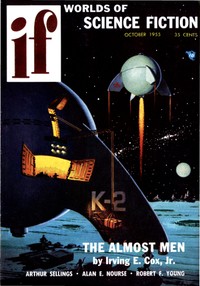
In Irving E. Cox Jr.'s 1955 novella, a young man named Lanny questions the necessity of war against technologically superior alien occupiers, as the narrative shifts from action to philosophical debate about freedom and self-destruction.
Editorial Edition Score
4.6/5
★★★★★
★★★★★
Calculated from edition completeness, EPUB availability, text structure and catalogue metadata. Not a user rating.
How this score is calculated
- Description quality20 pts
- Title & short description10 pts
- Source metadata20 pts
- Text length15 pts
- Chapters / structure15 pts
- EPUB file integrity20 pts
Total of 100 points, scaled to a 2.5-5.0 range. Editions with an empty description or a missing EPUB file are not scored.
Edition quality
Read the Text
What had happened last night? Lanny wracked his brain, trying to remember.
Eight hunters had been sent out to bring in a cache of rifles which Lanny's brother, Gill, had found in the rubble of Santa Barbara. It was risky business, because under the terms of the surrender treaty men were prohibited the use of all metals in the prison compounds. But the younger generation--boys like Lanny and Gill, born since the invasion--were more fiercely determined to resist the Almost-men than their elders. Armed with fifty rifles, they thought they would be strong enough to attack the Chapel of the Triangle.
The Almost-men: the children had coined the word, subtly asserting the pride of man. Yet they knew it was a semantic trick they played upon themselves. It changed nothing. The conquerors were physically identical to men; their enormous superiority was entirely technological.
As the eight hunters crept toward the ruins of Santa Barbara, through a narrow canyon, old man Barlow suddenly emerged from the brush and stood grinning at them. It was his privilege to join the hunters; any citizen of the settlement could have done so. But the younger generation hated Barlow. He was the practical man; he called himself a realist. He never allowed them to forget they were defeated, imprisoned and without weapons; he took savage delight in poking holes in their plans for resistance.
"What are you doing here?" Lanny's brother demanded.
"I came to watch the fun, Gill."
"We're going to bring back fifty rifles; that's all--"
"Right under the noses of our masters? Don't be naive."
"There's only one way the Almost-men would find out--"
Barlow snorted. "Don't think I ran to the Chapel of the Triangle and told Tak Laleen what you were up to. They don't need that sort of help from us. When are you going to get it through that thick skull of yours? We're outclassed; we're second-raters; we'll never defeat them."
From the night sky they heard the low hum of a force-field car. An opalescent sphere soared above the canyon. Gill's fist smashed into Barlow's jaw.
"So you did tell her!"
Barlow fell back against the canyon wall, his mouth bleeding.
The sphere came to a graceful stop thirty feet above the hunters and the de-grav platform lowered a woman toward the canyon. Surrounded by the faintly opaque capsule of her protective force-field, she moved toward them, a beautiful, dark-haired woman clothed in white.
This was Tak Laleen, the alien missionary assigned to the Santa Barbara area. She lived in the Chapel of the Triangle. Under the terms of the surrender treaty, the missionaries of the Almost-men were guaranteed immunity to preach and work in the treaty areas. They were selfless, generous and kind, yet men abhorred them, for they represented the tangible power of the conqueror.
Tak Laleen glided toward the hunters, forming the alien's triangular sign of peace with her small, white fingers. "I come in peace, in the name of the All of the Universe."
"We haven't violated any regulation," Gill snapped stiffly.
Barlow sidled toward her. "Take me back to the Triangle," he begged. "I'll tell you--"
Gill's fist lashed out again; Barlow reeled under the blow. "We're a legally elected punishment squad," Gill lied. "This man has broken a community law."
"You don't understand!" Barlow cried desperately. "They came to get--"
The other hunters fell on him, pummeling him into silence. The violence sickened Lanny, yet what alternative did they have? Lanny raised his club. At the same time the missionary came closer to the mob, and his club touched her forced-field capsule. Normally the energy would have paralyzed him with pain. But his mind refused to accept the normal, and Lanny felt the same sort of integrated unity with the energy field that he had with his hunting club. Command over the matter structure of the field. The energy flowed into his body and was absorbed, stored in an explosive concentration of power.
For a moment the opaque capsule dimmed. Tak Laleen clenched her hand over her mouth and fled into her sphere. The car soared up above the canyon.
Lanny swung his club again. Since Barlow must die, let him die quickly, without pain. Murder!--the accusation was a pang of agony in Lanny's mind. This violated everything Juan had taught him. He was aware that he wanted Barlow's death not because the old man had tried to betray the hunters, but because Lanny could not answer Barlow's poisonous despair in any other way. Lanny was ashamed. But who would know his real motive if he killed Barlow now? Who--but himself?
The novella opens with a jarring, sensory scene: Lanny is shaken awake by his foster father, Juan Pendillo, as enemy police spheres whine overhead. The prose is immediate and tactile—Lanny dresses in breeches, straps on a stone knife and wooden club—and the dialogue is terse, driven by urgency. Cox establishes a world where humans live in earth burrows, use homespun bandages, and rely on the sun to heal wounds, contrasting sharply with the unseen but ever-present technology of the Almost-men. The early pages are dominated by action and threat, with the narrative voice staying close to Lanny's groggy, guilt-ridden perspective. He cannot remember the previous night's events, and his fragmented recollection creates a sense of disorientation that mirrors the larger uncertainty of the human resistance.
From Action to Interior Conflict
After the initial chase, the story slows dramatically. Lanny returns to the treaty area, and the prose shifts from external action to internal rumination. Standing on a bridge, he fills his lungs with unsterilized air and wonders how the Almost-men can think clearly amid their machines. This moment of reflection is the pivot: the narrative voice becomes more abstract, posing questions about freedom and slavery. Cox uses Lanny's walk to Juan Pendillo's house to transition into a debate scene. The dialogue here is measured, almost philosophical, as Lanny struggles to articulate his growing doubt about capturing the enemy city. The pacing change is stark—from the breathless escape to a quiet, tense conversation where the elders exchange knowing glances. This structural shift emphasizes that the real conflict is not physical but ideological.
Recurring Details and Semantic Tension
Cox repeatedly draws attention to language as a tool of resistance. The children coined the word Almost-men as a semantic trick to assert human pride, yet the narrator notes it changes nothing. This self-awareness about the limits of words recurs: Lanny later bursts into the room excitedly, but the words are gone; he cannot explain his conviction. The novella also lingers on physical details that carry symbolic weight: the crude mock-up of a living energy unit that Tak Laleen handles, the stone knife and wooden club versus energy guns, the earth under bare feet versus sterilized city air. These contrasts are not merely descriptive—they underpin the central paradox Lanny grapples with: that the victor may be the slave. The narrative voice remains close to Lanny's limited understanding, allowing the reader to experience his confusion without authorial intrusion.
Voice and the Unreliable Memory
Lanny's memory is a fault line in the narrative. He cannot recall the explosion or his actions the previous night, and he feels a pang of guilt he cannot explain. Cox uses this gap to create suspense and to question Lanny's reliability as a narrator. When Lanny later claims Barlow was a spy, he knows he is lying, but the source of the lie is unclear. The narrative voice does not correct him; it stays inside his flawed perception. This technique keeps the reader uncertain about what really happened and what Lanny might have done. The missionary Tak Laleen, an outsider, provides a contrasting perspective—her face drawn, her laughter hysterical—but her viewpoint is filtered through Lanny's observations. The result is a layered, ambiguous account where the truth is as fragmented as Lanny's memory.
Readers should pay close attention to the moments when the narrative slows or when Lanny pauses to think. These are not digressions but the core of the story. Cox is less interested in the mechanics of the rebellion than in the moral and psychological cost of resistance. The novella rewards careful reading of its dialogue and internal monologue, where the real action—the questioning of assumptions—takes place. The ending, though not included here, is likely to hinge on whether Lanny resolves his doubt or is consumed by it.
Sometimes I still think about Lanny, how he wondered if fighting was worth it when the aliens already owned everything. That quiet ache of questioning your own side stayed with me. The God-Plllnk — Context and Discussion reminded me of it, that same slow unease about what we call freedom. It lingered gently, like a half-remembered conversation.
There are no reviews for this eBook.
There are no comments for this eBook.
Reader reflection
Before you leave, reflect on the book
Use these questions to collect your thoughts before moving on.
Your progress
0
/
10
2
Was reading this book enjoyable?
3
How likely are you to recommend this book?
4
How demanding did the text feel?
5
What did you think about the pace?
6
What did you appreciate most?
7
Was the book what you thought it would be?
8
Did any part of the book feel personally relevant?
9
What did this book teach you most?
10