
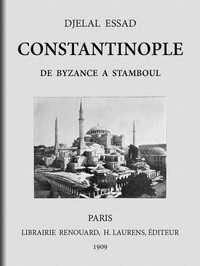
Constantinople de Byzance à Stamboul. by Celâl Esad Arseven
Celâl Esad Arseven's book isn't a novel with a plot in the traditional sense. Instead, its 'story' is the epic, real-life transformation of one of the world's greatest cities.
The Story
Arseven takes us on a guided tour through time. He starts with the small Greek colony of Byzantium, perched on the edge of the known world. Then, he shows us Emperor Constantine's monumental decision that changed everything: making this city the new heart of the Roman Empire and naming it after himself. We see the rise of magnificent churches, the famous walls, and a culture that blended Roman law, Greek language, and Christian faith for a thousand years.
The story takes a dramatic turn with the Ottoman conquest in 1453. This isn't just presented as a destruction, but as a profound change. Mosques with towering minarets rise, palaces are built, and a new, vibrant Islamic and Turkish character blends with what was already there. Finally, Arseven brings us to his own era, as the city sheds its imperial title 'Constantinople' and fully embraces the name 'Istanbul' in the modern Turkish Republic.
Why You Should Read It
What makes this book special is the author's voice. Arseven wasn't just a historian; he was an artist and architect who lived from the Ottoman era into the modern Turkish state. He writes about the city's architecture, art, and daily life with a connoisseur's eye. You get the sense he's walking you through neighborhoods he knows intimately, pointing out a Byzantine mosaic hidden in a mosque wall, or explaining how an Ottoman house is perfectly adapted to the climate.
He avoids simple 'clash of civilizations' ideas. Instead, he shows a city that is constantly adapting, absorbing, and remaking itself. The Greek, Roman, Christian, and Islamic layers aren't separate; they're fused into something unique. Reading this, you understand that Istanbul's magic comes from this impossible, beautiful mixture.
Final Verdict
This book is perfect for anyone who is fascinated by how cities evolve. It's for the traveler who wants to understand Istanbul beyond the guidebook highlights, for the history lover who enjoys cultural history over battle dates, and for the reader who likes their non-fiction to have a strong, personal perspective. It's not a quick, breezy read, but a rich, detailed portrait. If you let it, it will completely change how you see—and hear the story in—the stones of an ancient city.
No rights are reserved for this publication. Distribute this work to help spread literacy.
Linda Martin
5 months agoExtremely helpful for my current research project.
Elizabeth Thompson
5 months agoHaving followed this topic for years, I can say that the practical checklists included are a great touch for real-world use. This exceeded my expectations in almost every way.
Elizabeth Harris
2 months agoThe layout of the digital version made it easy to start immediately, the breakdown of complex theories into digestible segments is masterfully done. A rare gem in a sea of mediocre content.
Barbara Garcia
2 months agoAs a long-time follower of this subject matter, the step-by-step breakdown of the methodology is extremely helpful for students. Simple, effective, and authoritative – what else could you ask for?








Donald White
3 months agoThe clarity of the concluding remarks is very professional.